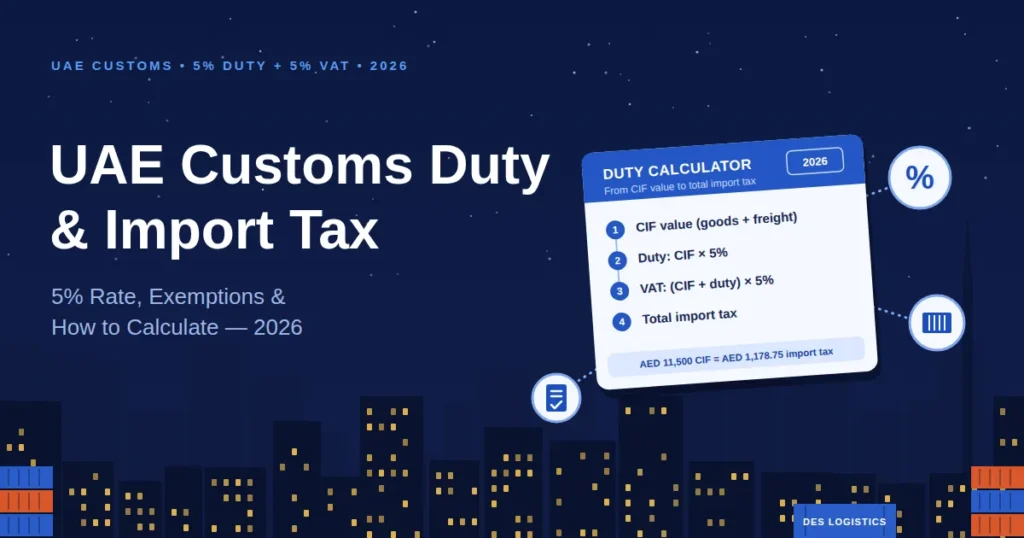
Customs duty in the UAE is 5% of the CIF value (cost, insurance and freight) for most goods imported from outside the GCC. On top of that, importers pay 5% VAT, charged on the CIF value plus the duty. Alcohol is charged at 50% and tobacco at 100%, while free zones, GCC-origin goods, trade agreements and a list of essential items can reduce or remove the duty.
This guide explains the UAE customs duty rates, how to calculate Dubai import tax step by step with real examples, which goods are exempt, and how custom duty clearance works in practice, so you can budget for a shipment before it lands.
Quick answer
- Standard customs duty: 5% of CIF value for most goods from outside the GCC.
- VAT on imports: 5%, calculated on CIF value plus customs duty.
- Higher rates: alcohol 50%; tobacco 100% (plus excise tax); some goods such as certain tiles, cement and batteries attract anti-dumping duties.
- Formula: (CIF value × 5%) + 5% VAT on (CIF value + duty).
- Possible relief: free zones, GCC-origin goods, free trade agreements, temporary admission, and exempt essentials.
What Is Customs Duty in the UAE?
Customs duty, sometimes written as custom duty, is a tax charged by UAE Customs when goods enter the country from outside the GCC customs union. It is calculated as a percentage of the goods’ customs value and is paid when the customs declaration is cleared. The rate follows the GCC Common Customs Tariff, so the same system applies across the Gulf states.
Dubai Customs runs the process in Dubai’s ports, airports, free zones and land borders, and importers file declarations through the Dubai Trade portal using a registered customs code.
Customs duty vs import tax vs VAT vs excise
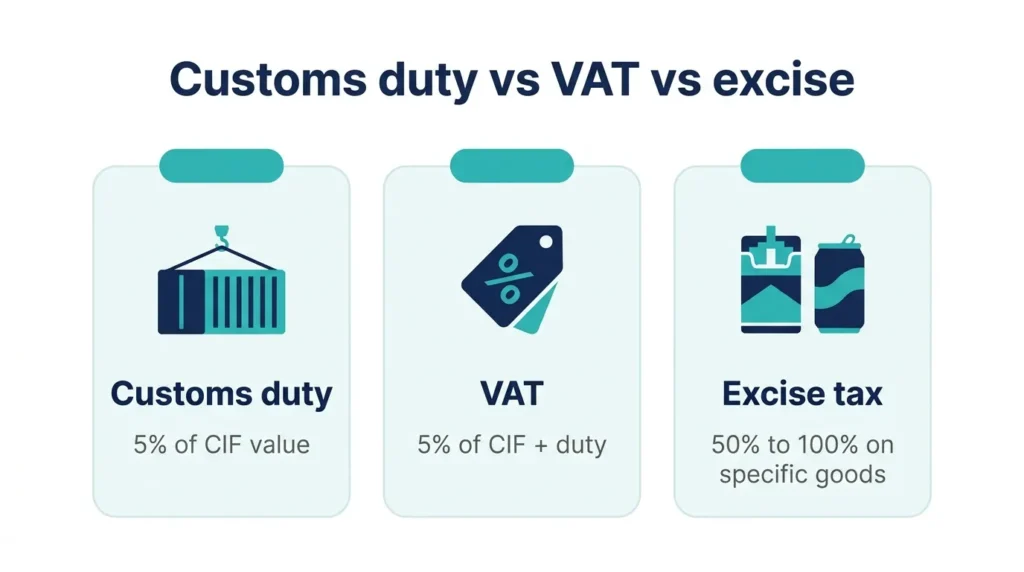
People often say Dubai import tax to mean everything charged at the border. In reality there are three different charges:
| Charge | Rate | Basis |
|---|---|---|
| Customs duty | 5% for most goods (0% to 100% for some) | CIF value |
| VAT on imports | 5% | CIF value + customs duty |
| Excise tax | 50% to 100% on specific goods (tobacco, certain drinks) | Charged in addition to duty on excise goods |
UAE Customs Duty Rates
| Goods | Customs duty | Notes |
|---|---|---|
| Most goods (electronics, clothing, furniture, machinery, spare parts) | 5% of CIF | The standard GCC rate |
| Alcoholic beverages | 50% of CIF | Alcohol imports are tightly controlled |
| Tobacco and cigarettes | 100% of CIF | Plus excise tax; minimum specific amounts apply |
| Basic foodstuffs, medicines, books and some other essentials | Exempt or 0% | Depends on the HS code; check before shipping |
| Goods from some trade-agreement partners | Reduced or 0% | Needs a valid certificate of origin |
| Certain products (for example some tiles, cement, batteries) | Extra anti-dumping duty | Depends on HS code and country of origin |
The 5% rate has been in place since 2003. These are the headline rates published by Dubai Customs and the GCC tariff, but the exact rate for your product depends on its HS code, so always classify the goods before you quote a landed cost.
How to Calculate Customs Duty and Import Tax in Dubai
The calculation takes three steps.
- Find the CIF value. CIF = goods value + insurance + freight to the UAE. Convert to AED using the exchange rate on the day the declaration is submitted.
- Calculate customs duty. Duty = CIF value × duty rate (5% for most goods).
- Calculate VAT. VAT = (CIF value + customs duty) × 5%. Add the duty and VAT to get your total import tax.
Example 1: electronics shipment
| Item | Amount (AED) |
|---|---|
| Goods value | 10,000.00 |
| Insurance | 500.00 |
| Freight | 1,000.00 |
| CIF value | 11,500.00 |
| Customs duty at 5% | 575.00 |
| VAT at 5% on (11,500 + 575) | 603.75 |
| Total import tax | 1,178.75 |
Example 2: larger commercial shipment
CIF value AED 50,000. Customs duty at 5% = AED 2,500. VAT at 5% on AED 52,500 = AED 2,625. Total import tax = AED 5,125.

A customs duty calculator helps, but only if you enter the right HS code and CIF value. A wrong HS code is the most common reason the final bill differs from the estimate.
Dubai Import Tax: VAT on Imported Goods
VAT of 5% applies to goods imported into the UAE regardless of value. It is charged on the CIF value plus customs duty, which is why VAT is slightly higher than 5% of the invoice. VAT-registered businesses can usually recover import VAT through their VAT return, subject to the rules of the Federal Tax Authority, so it is a cash-flow cost rather than a permanent cost. Always check how import VAT will be treated for your company with your tax adviser.
Customs duty is a real cost that is not recoverable, which is why correct classification, valuation and use of exemptions matter so much.
Customs Duty Exemptions in the UAE
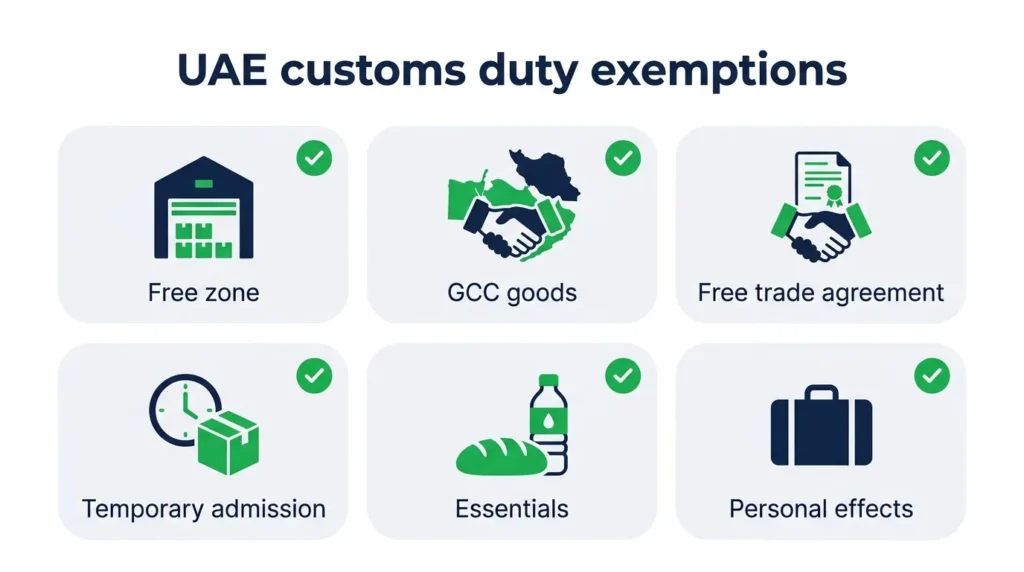
Not every shipment pays the full 5%. The main exemptions and reliefs are:
- Free zones: goods imported into a free zone such as Jebel Ali are not charged duty while they stay inside. Duty and VAT apply when the goods move to the mainland.
- GCC-origin goods: goods that already paid duty in another GCC state are generally not charged again within the customs union. A certificate of origin helps.
- Free trade agreements: goods from partner countries, such as those covered by the UAE’s CEPAs with India and Indonesia, may enjoy reduced or zero duty with a valid certificate of origin.
- Temporary admission: goods imported for exhibitions or repair can enter with a refundable deposit or ATA carnet, and are re-exported later.
- Essential goods: many basic foodstuffs, medicines and medical supplies, books and educational materials, and humanitarian relief goods are exempt or zero-rated.
- Personal effects: used household items for new residents or returning residents, in non-commercial quantities, can qualify for relief with supporting documents.
- Industrial inputs: licensed manufacturers can apply for exemption on raw materials and machinery through the relevant government platform.
- Low-value courier consignments: Dubai has applied a customs-duty exemption threshold of about AED 980 (SAR 1,000) for courier consignments since March 2023. Alcohol, tobacco and e-cigarettes are always dutiable. Check the current threshold before relying on it.
Free Zone vs Mainland: Where Duty Is Charged
Free zones suspend duty, but they do not cancel it. If you import into Jebel Ali Free Zone or another zone and later sell or move the goods onto the mainland, customs duty and VAT become payable at that point. If you re-export the goods outside the UAE, you generally do not pay duty. Because the rules depend on the transaction, confirm your case with customs or a clearing agent. Our warehousing service can help store goods while you decide the right route.
Custom Duty Clearance in Dubai: Step by Step
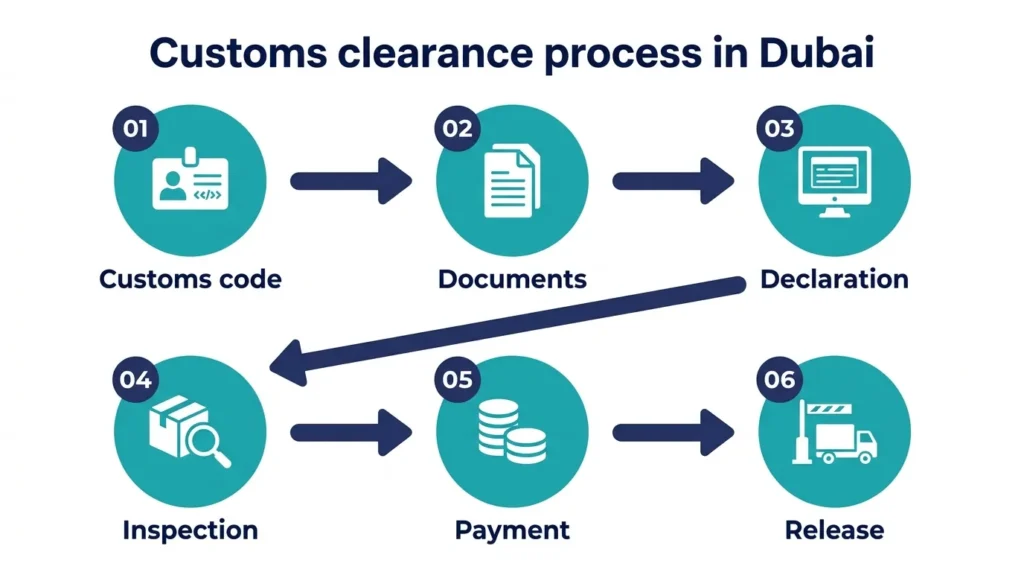
Custom duty clearance is the process of declaring your goods, paying the duty and VAT, and getting them released. It follows these steps.
- Get a customs code. The importer registers with Dubai Customs through the Dubai Trade portal. Dubai Customs lists a registration fee of AED 100 and processing in about one working day, with the trade licence and authorised person’s documents.
- Prepare documents. Commercial invoice, packing list, bill of lading or air waybill, certificate of origin and permits for regulated goods. See our guide on documents required for customs clearance in Dubai.
- File the customs declaration. The importer or clearing agent submits the declaration with the HS codes and value. Dubai Customs lists a declaration processing time of about 2 working hours.
- Risk assessment and inspection. Customs may release the goods, ask for documents or inspect the cargo. Inspections requested by customs are free; those requested by the importer carry a fee.
- Pay duty and VAT. Payment is made online, after which the goods are released.
- Collect or deliver. Cargo is collected from the port or airport, or delivered by road transport.
Most importers hand this to a licensed clearing agent. Our customs clearance service handles the declaration, duty payment and release for sea, air and land cargo.
Time Limits, Fees and Penalties to Know
- Documents after declaration: documents should be submitted within 30 days of processing. After that, Dubai Customs lists a late fee of AED 5 per day.
- Declaration fee: Dubai Customs lists import declaration fees of roughly AED 30 to AED 100, depending on the type of declaration and goods.
- Storage limits: Dubai Customs lists about 3 months for general sea cargo and air or land cargo before goods can go to public auction, and about 1 month for refrigerated and dangerous cargo.
- Misclassification and under-valuation: can lead to extra duty, fines and delays.
Fees and limits are updated by Dubai Customs from time to time, so treat these as a guide and confirm the current figures.
How to Reduce Customs Duty Legally
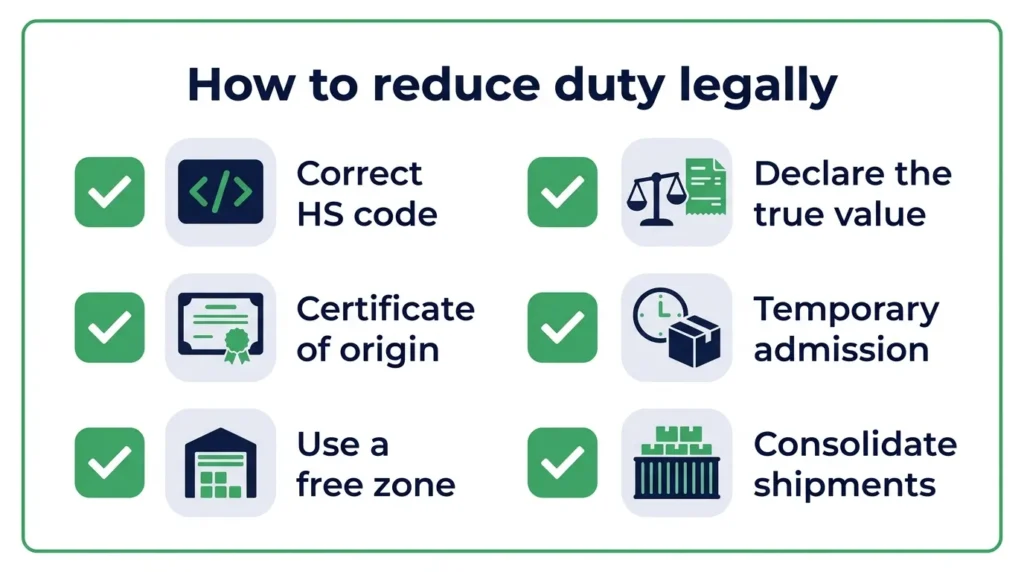
- Use the correct HS code. A wrong code can mean paying 5% instead of 0%, or the other way round.
- Claim trade-agreement benefits with a valid certificate of origin.
- Use free zones or bonded storage if you re-export or only need goods on the mainland later. See warehousing.
- Declare the true value. Customs checks values against its database, and under-declaration costs more later.
- Use temporary admission or ATA carnets for exhibition and repair goods.
- Consolidate shipments to reduce per-declaration costs and handling.
Common Mistakes That Increase Your Import Tax Bill
- Using an incorrect or vague HS code
- Not adding freight and insurance to the CIF value
- Missing certificate of origin, so FTA relief is lost
- Forgetting that free-zone goods become dutiable on mainland entry
- Missing permits for regulated goods such as food, medicine, telecom and chemicals, see dangerous cargo handling for hazardous goods
- Late document submission and storage charges
Customs Duty for Air and Sea Shipments
The duty rules are the same whether cargo arrives by air, sea or road. What changes is the timing and the paperwork: air cargo is cleared in hours, sea cargo can sit in port longer, and storage charges apply if clearance is delayed. If you ship regularly, learn the basics of air freight and compare it with sea freight forwarding to see which gives the best landed cost.
UAE Customs Clearance with Des Logistics
Des Logistics is a Dubai-based logistics company with customs, freight and warehousing under one roof in Business Bay. We help importers with HS classification, duty and VAT estimates, customs declarations and delivery, using our customs clearance, air freight and sea freight services.
- Duty and VAT estimate before shipment
- Customs declaration and document checking
- Dangerous and restricted goods handling
- Storage and delivery across the UAE
- WhatsApp support on +971 55 8251353
Want an estimate for your shipment? Send us the invoice and packing list and we will confirm the duty, VAT and clearance cost.
Frequently Asked Questions
What is the customs duty rate in the UAE?
The standard customs duty rate is 5% of the CIF value for most goods imported from outside the GCC. Alcohol is charged at 50% and tobacco at 100%.
What is the import tax in Dubai?
There is no single “import tax”. Importers pay customs duty (usually 5% of CIF) plus 5% VAT on the CIF value plus duty, and excise tax on specific goods.
How do I calculate customs duty in Dubai?
Add goods value, insurance and freight to get the CIF value, multiply by the duty rate (5% for most goods), then add 5% VAT on CIF plus duty.
Is customs duty always 5%?
No. Most goods are 5%, but some are exempt or reduced, and alcohol, tobacco and some products with anti-dumping measures are higher.
Do I pay customs duty in a free zone?
Not while the goods stay in the free zone. Duty and VAT apply when goods move to the mainland.
Is there a duty-free limit for courier shipments to Dubai?
Dubai has applied a threshold of about AED 980 (SAR 1,000) for courier consignments since March 2023, but alcohol, tobacco and e-cigarettes are always dutiable. Check the latest notice before shipping.
Can I get a refund of customs duty?
In some cases, for example when goods are re-exported or a deposit was paid for temporary admission. Conditions apply, so check with customs or your agent.
Who pays customs duty, the buyer or the seller?
It depends on the Incoterm. Under DDP the seller pays; under most others (such as FOB or CIF) the importer in the UAE pays.
How long does customs clearance take in Dubai?
The declaration itself is processed in a few hours. Total clearance depends on documents, inspection and payment, and is often 1 to 3 days for complete paperwork.
What is the difference between customs duty and VAT?
Customs duty is a tax on imported goods that is not recoverable. VAT is charged on top and is usually recoverable by VAT-registered businesses.
Final Thoughts
UAE customs duty is simple at the headline level, 5% of CIF plus 5% VAT, but the final bill depends on HS code, valuation and the exemptions you claim. Calculate before you ship, prepare clean documents, and use a licensed agent for the declaration. For help with customs duty and clearance in Dubai, contact Des Logistics.
Rates, thresholds and fees change. Confirm current figures with Dubai Customs and the Federal Tax Authority before you rely on them.