You have a supplier overseas, a buyer lined up, and a shipment ready to go. Then Dubai Customs asks for your importer code, and you realise a trade licence alone is not enough. That one missing piece can hold a container at the port while storage charges build up every day.
This guide explains exactly what an import export license in Dubai costs, which type you need, which documents to prepare, and how to get cleared to trade in 2026.
How Much Does an Import Export License Cost in Dubai?
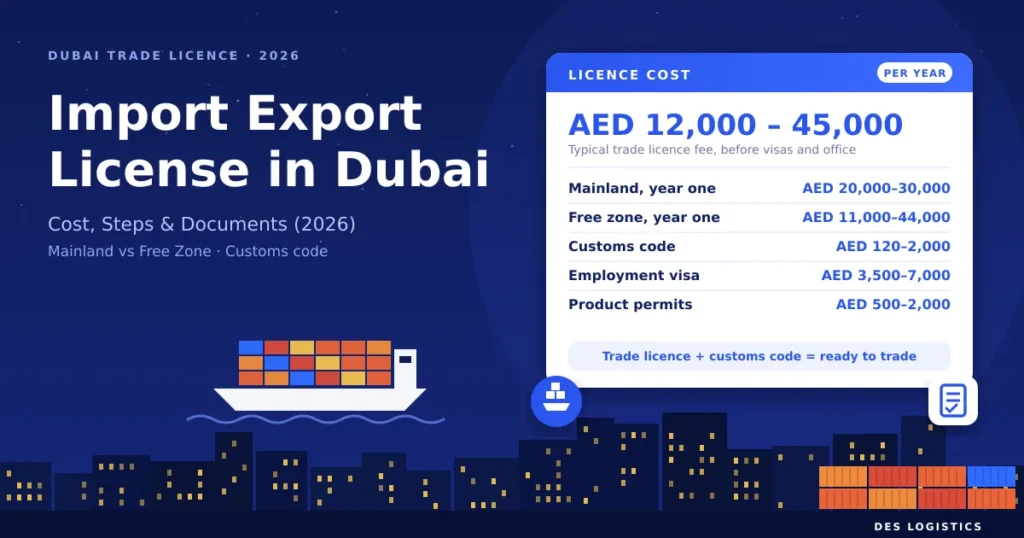
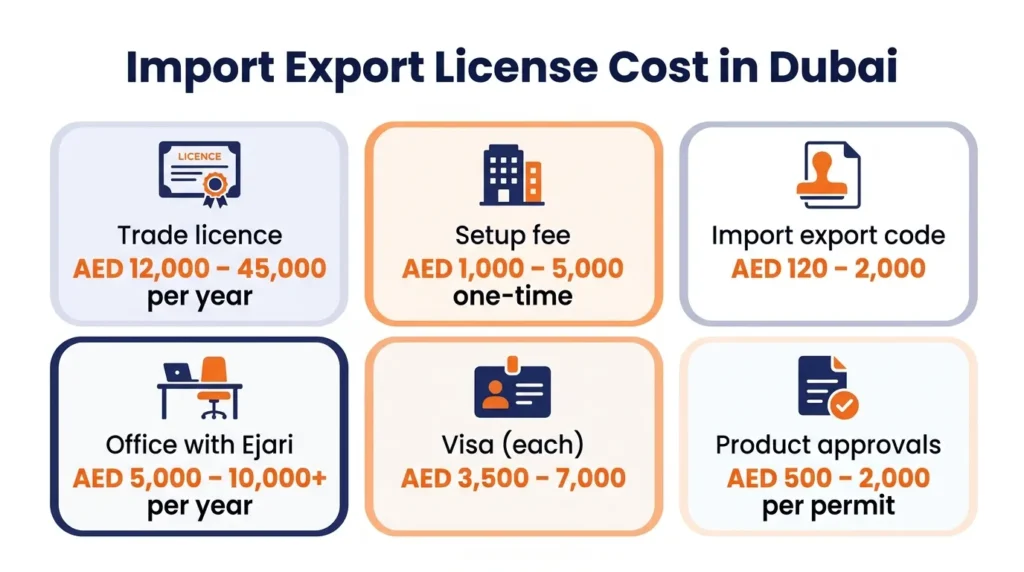
Short answer: an import export license in Dubai typically costs between AED 12,000 and AED 45,000 per year. A mainland setup usually lands around AED 20,000–30,000 in year one once the trade licence, office space and customs code are added. Free zone packages can start lower, but the real total depends on visas, office type and special approvals.
The table below shows what you should budget for.
| Cost item | Typical cost (AED) |
|---|---|
| Trade licence fee (mainland or free zone) | 12,000 – 45,000 per year |
| Company registration / setup fee | 1,000 – 5,000 (one-time) |
| Import export code (customs registration) | 120 – 2,000 |
| Office space or virtual office with Ejari | Varies; often 5,000 – 10,000+ per year |
| Employment visa (each) | 3,500 – 7,000 |
| Special product approvals | 500 – 2,000 per permit |
| Late renewal penalties | 2,000 – 5,000+ |
These are market estimates. Fees change by authority and activity, so confirm the final quote with your licensing authority or business setup consultant before you commit.
Import Export License Fees: Mainland vs Free Zone
The biggest factor in your import export license fees is where you register. Here is how the two main routes compare.
| Mainland | Free zone | |
|---|---|---|
| Issued by | Dubai Economy and Tourism (DET) | The free zone authority (for example DMCC, JAFZA, IFZA, SHAMS) |
| Typical first-year cost | AED 20,000 – 30,000 | Roughly AED 11,000 – 44,000 depending on the zone and package |
| Sell directly in the UAE market | Yes | No, needs a mainland distributor or a dual licence |
| Office requirement | Physical office or Ejari-registered space | Flexi-desk or virtual office in many zones |
| Customs duty | 5% on most imports (CIF value) | Duty suspended inside the zone; applies when goods enter the mainland |
| Foreign ownership | Up to 100% for most trading activities | 100% |
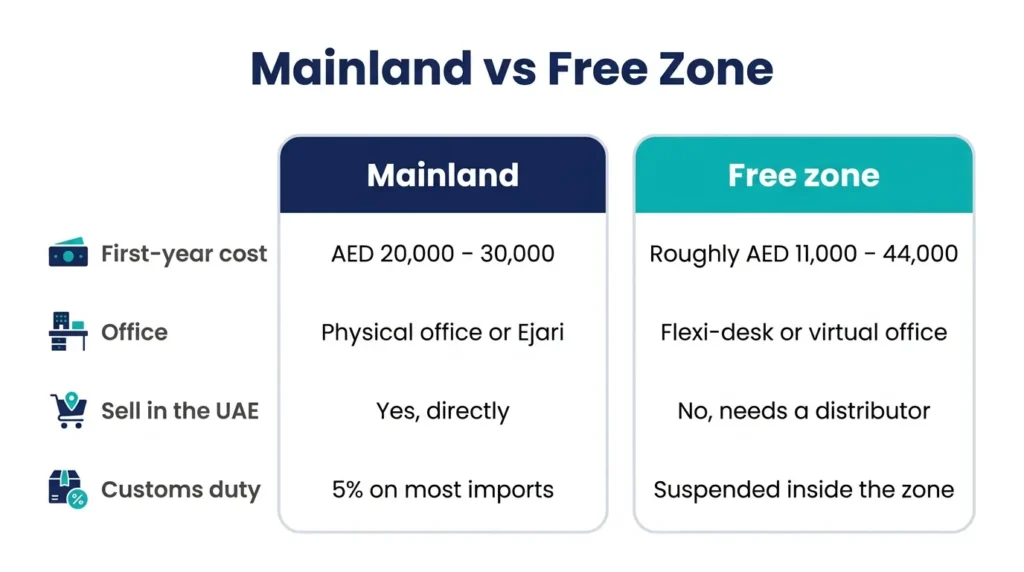
Which one is cheaper? Free zones are usually cheaper to start, especially if you re-export or sell to overseas buyers. Mainland costs more but lets you sell straight to UAE customers without a middleman. Pick based on who your buyers are, not only on the sticker price.
What Is an Import and Export License in Dubai?
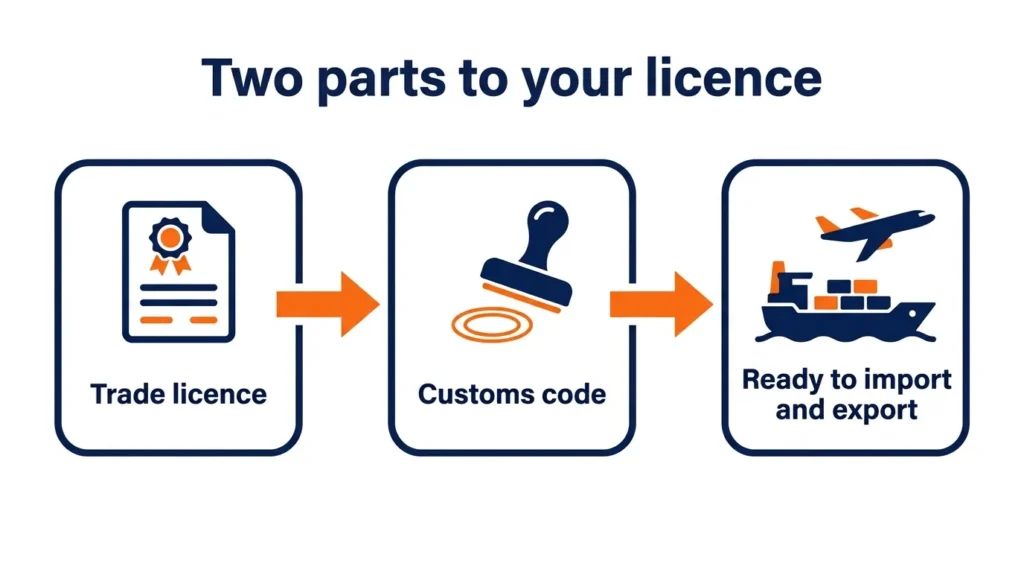
An import and export license in Dubai is the legal permission for your company to bring goods into the UAE and send goods out. In practice it has two parts:
- A trade licence with an import, export or general trading activity, issued by DET (mainland) or a free zone authority.
- An import export code, also called a Customs Client Code, issued after you register with Dubai Customs.
Without the code, you cannot clear a shipment through Dubai ports or airports. Many first-time traders get the trade licence and assume they are finished. They are not.
Import Export Licence vs General Trading Licence
You will see both “import export licence” and “general trading licence” online, and they are closely related. A general trading licence usually allows you to deal in many product categories, while a narrower import export activity covers specific goods. Regulated goods such as food, cosmetics, medicines and chemicals need extra approvals from authorities like Dubai Municipality or the Ministry of Health before customs will release them.
Ask your consultant to list your exact HS codes against the licence activities so nothing is rejected at clearance. Our HS Code Guide explains how to find the right code.
Which Type of Import Export Business License Do You Need?
Your import export business license depends on where your customers are.
- Mainland licence: best if you sell to UAE retailers, contractors or the public.
- Free zone licence: best if you store, trade and re-export, and want lower setup costs.
- Offshore company: useful for holding or invoicing structures, but it cannot obtain an import export code for direct customs clearance. It must work through a licensed local company.

Documents Required for an Import Export License in Dubai
Prepare these before you apply. Missing paperwork is the most common cause of delay.
- Passport copies of all shareholders and managers
- Passport-size photographs
- UAE visa page and Emirates ID, if you are already a resident
- Proposed company name (2–3 options)
- Business activity and HS codes of the goods you plan to trade
- Memorandum of Association or free zone application form
- Tenancy contract (Ejari) or free zone lease or flexi-desk agreement
- No-objection certificate if you are on a sponsored visa
- Initial approval and any product-specific permits for regulated goods

How to Get an Import Export License in Dubai: Step by Step
Here is the process from first idea to first shipment.
- Choose your jurisdiction. Decide between mainland and a free zone based on your buyers, budget and visa needs.
- Pick your business activity. Select import, export or general trading and match it to your HS codes.
- Reserve your trade name. Submit 2–3 options. The name must follow UAE naming rules.
- Get initial approval. The authority confirms your activity and structure.
- Secure office space. Sign an Ejari-registered lease for mainland, or a flexi-desk or lease in your free zone.
- Sign the MOA or application. Mainland companies sign a Memorandum of Association. Free zones use their own agreement.
- Pay the fees and receive your trade licence. Free zones often issue it within 7–14 working days. Mainland approvals usually take 2–4 weeks.
- Register with Dubai Customs. Apply for your import export code. This takes a few more working days.
- Get product permits. If you trade regulated goods, obtain approvals before the shipment arrives.
- Appoint a clearing and forwarding partner. Hand your shipment documents to a licensed customs clearance agent.


How Long Does It Take to Get an Import Export License in Dubai?
Plan on 2–4 weeks in total for most applications. Free zones are generally faster, often 7–14 working days for the licence, with the customs code added on top. Mainland takes longer because of extra approvals and office registration. Incomplete documents and regulated products are what push timelines past a month.
Import Export License Cost in Dubai: Hidden Costs to Plan For
The licence fee is only part of your budget. Many first-year totals reach close to double the licence fee once everything is added. Watch for these:
- Visa and Emirates ID costs for each employee
- Office or flexi-desk upgrades if your activity needs more space
- Product permits for food, cosmetics, chemicals or electronics
- Customs duty at 5% of CIF value on most mainland imports
- Clearance, port and storage charges when your shipment arrives
- Renewal fees and penalties if you renew late

How to Reduce Your Import Export License Cost
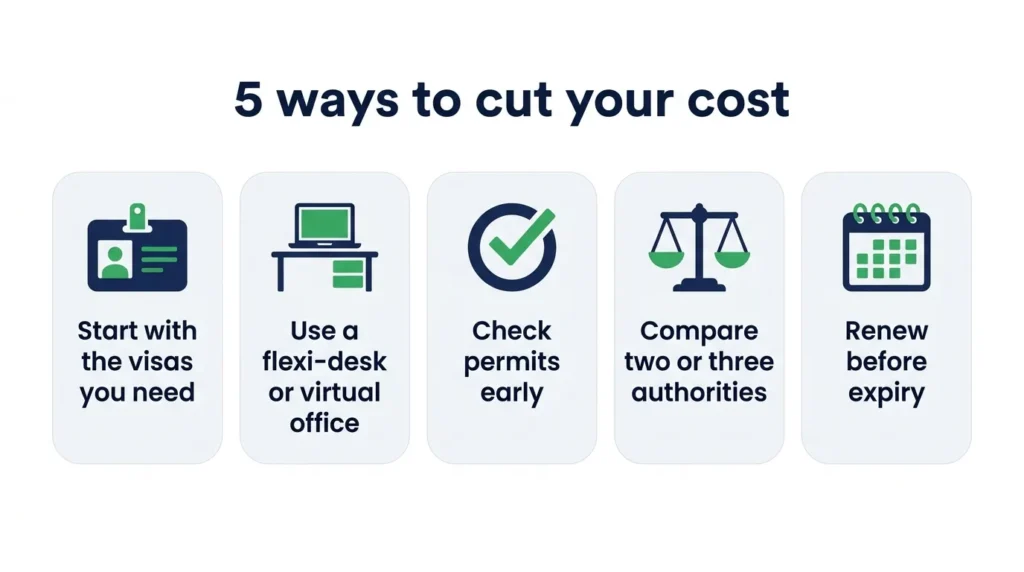
These practical steps can lower your first-year spend:
- Start with the visas you need now. Add more as the business grows.
- Use a flexi-desk or virtual office where your authority allows it.
- Check product permits early so you do not pay storage while waiting for approval.
- Compare two or three authorities before choosing, because bundled packages differ.
- Renew before expiry to avoid penalties and customs delays.
What Happens After You Get Your License?
Your licence lets you trade, but cargo still has to move. After registration you will need to:
- Classify goods under the correct HS code
- Prepare the commercial invoice, packing list and bill of lading or airway bill
- Submit the customs declaration and pay duty where applicable
- Arrange transport from the port or airport to your warehouse
This is where an experienced partner saves time and money. DES Logistics handles freight forwarding and customs clearance under one roof, so your cargo does not get stuck between two providers. See our Customs Clearance services and Freight Forwarding services.

Renewing Your Import Export License
You must renew your licence every year. Renewal fees are close to your original licence fee, plus visa renewals and any permit renewals. Late renewal can bring fines starting around AED 2,000 and may block your customs code, so set a reminder at least 30 days before expiry.

Common Mistakes to Avoid
- Getting a trade licence but forgetting the customs code
- Choosing a free zone and then trying to sell directly to UAE customers
- Ignoring product permits until the cargo has arrived
- Selecting the wrong activity so HS codes do not match
- Budgeting only for the licence fee

Frequently Asked Questions
How much does an import export license cost in Dubai?
Most businesses pay between AED 12,000 and AED 45,000 per year. Mainland setups with a licence, office and customs code usually come to about AED 20,000–30,000 in the first year. Free zone packages vary by zone.
Do I need a customs code to import goods into Dubai?
Yes. You must register with Dubai Customs to get an import export code. Without it you cannot clear shipments at Dubai ports or airports.
Can a free zone company import and sell in the UAE mainland?
Not directly. A free zone company usually needs a mainland distributor or a separate mainland licence to sell inside the UAE market.
Do I need a physical office?
Most mainland setups need an Ejari-registered office, though a virtual office is accepted for some activities. Many free zones allow a flexi-desk.
How long does it take to get an import export license in Dubai?
Around 2–4 weeks in most cases. Free zones can be faster, often 7–14 working days for the licence.
What is the customs duty on imports into Dubai?
Most goods imported into the mainland attract 5% duty on the CIF value. Goods held inside free zones are generally not charged duty until they enter the mainland.
Can foreigners own 100% of an import export company?
Yes. Foreigners can own 100% in free zones and in most mainland trading activities. A few regulated activities may still have conditions.
What documents do I need?
Passports, photos, Emirates ID if resident, trade name, activity and HS codes, MOA or free zone application, and a tenancy or flexi-desk agreement.
Can I import food, cosmetics or medicines with a normal licence?
Not without extra approvals. These goods need permits from bodies such as Dubai Municipality or the Ministry of Health.
What happens if I do not renew on time?
You may face fines starting around AED 2,000, and your customs code and trading rights can be suspended.
Final Thoughts
An import export license in Dubai is a two-part job: the trade licence and the customs code. Budget AED 12,000–45,000 for the licence, add visas, office and permits, and decide early whether mainland or a free zone fits your buyers. Get that choice right and the rest of the process is straightforward.
Once you are licensed, your next challenge is moving cargo without delays. Still not sure which service you need? Contact DES Logistics — we handle both under one roof.