
Abu Dhabi customs clearance is handled by the General Administration of Abu Dhabi Customs, and almost everything is now done online. You register for a customs number linked to your trade licence, file your declaration through the TAMM or ATLP platforms, pay duty and VAT, and the cargo is released. Many shipments are cleared before they even arrive.
This guide explains the Abu Dhabi customs clearance procedure step by step, the documents you need, the fees, how it differs from Dubai, and the mistakes that delay cargo.
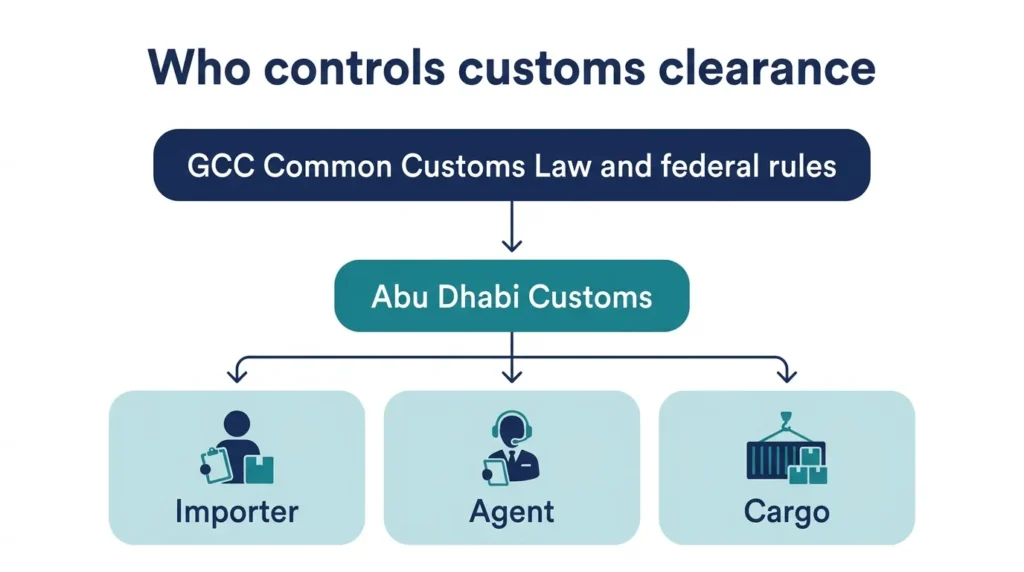
- Authority: the General Administration of Abu Dhabi Customs, working under the GCC Common Customs Law and UAE federal rules.
- Where you file: the Abu Dhabi government platform TAMM, or the Advanced Trade and Logistics Platform (ATLP).
- First step: a customs registration number tied to your trade licence. Customs numbers are emirate-specific, so a Dubai customs code does not automatically cover Abu Dhabi.
- Duty and tax: 5% customs duty on most goods, plus 5% VAT on imports. Some goods are exempt or taxed differently.
- Speed: pre-arrival clearance is widely used. Abu Dhabi Customs reported it made up 82% of clearance procedures from January to August 2025.
- Agent option: you can authorise a clearing agent in the Abu Dhabi Customs system to file for you.
Who Controls Customs Clearance in Abu Dhabi?
Customs in the UAE work on two levels. The substantive rules, such as how goods are valued and what a customs declaration is, come from the GCC Common Customs Law and federal legislation. The administration is local: your declaration is filed with, inspected by and audited by the customs authority of the emirate where the goods enter. For Abu Dhabi, that is Abu Dhabi Customs.
Abu Dhabi Customs offers its main services online, including clearance of goods, customs registration numbers, clearing agent delegation, duty refunds and declaration changes. Abu Dhabi Customs has also issued a package of new customs decisions in June 2026, so check the latest rules or ask your customs broker before filing.
Abu Dhabi Customs Clearance Procedure (Step by Step)
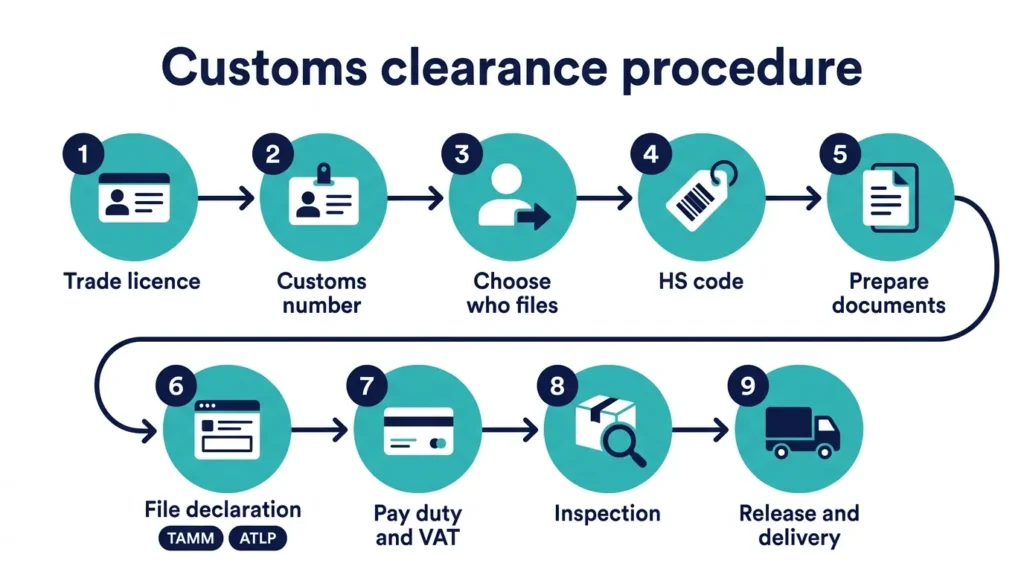
The Abu Dhabi customs clearance procedure follows the same logic as the rest of the UAE, with Abu Dhabi’s own systems and registrations.
- Hold a valid trade licence. For a mainland Abu Dhabi business, this is an economic licence from the Abu Dhabi Department of Economic Development. Free zone companies use their free zone licence.
- Get your customs registration number. Apply through TAMM using the Abu Dhabi Customs service for issuing a customs registration number. This number identifies you on every declaration. It is normally renewed every year, so check the expiry date.
- Decide who will file. You can file yourself, or authorise a licensed clearing agent through the Clearance Agent Delegation service so the agent can submit declarations on your behalf.
- Classify your goods. Find the right HS code for each product, because it sets the duty rate and shows restrictions. Abu Dhabi offers a smart classification tool on TAMM and ATLP. Our HS code guide explains how to choose the code.
- Prepare the documents (see the table below) and check that names, values and quantities match across all of them.
- File the customs declaration. Use the Clearance of Goods service on TAMM or the ATLP platform. You can file before the cargo arrives, which is known as pre-arrival clearance.
- Pay duty, VAT and fees electronically. Payment is made online, and the release is issued when the declaration is cleared.
- Inspection, if selected. Cargo may be examined based on risk. If the goods match the declaration, clearance continues.
- Release and delivery. Once cleared, the cargo is collected from the port, airport or border point and delivered.
Abu Dhabi Customs reported that its updated Clearance of Goods service on TAMM cut the number of steps from 13 to two, with some data filled in automatically, depending on the shipment type.
Custom Clearance in Abu Dhabi: Documents Required
Clean paperwork is the best way to avoid delays. The exact list depends on the goods and the mode of transport.
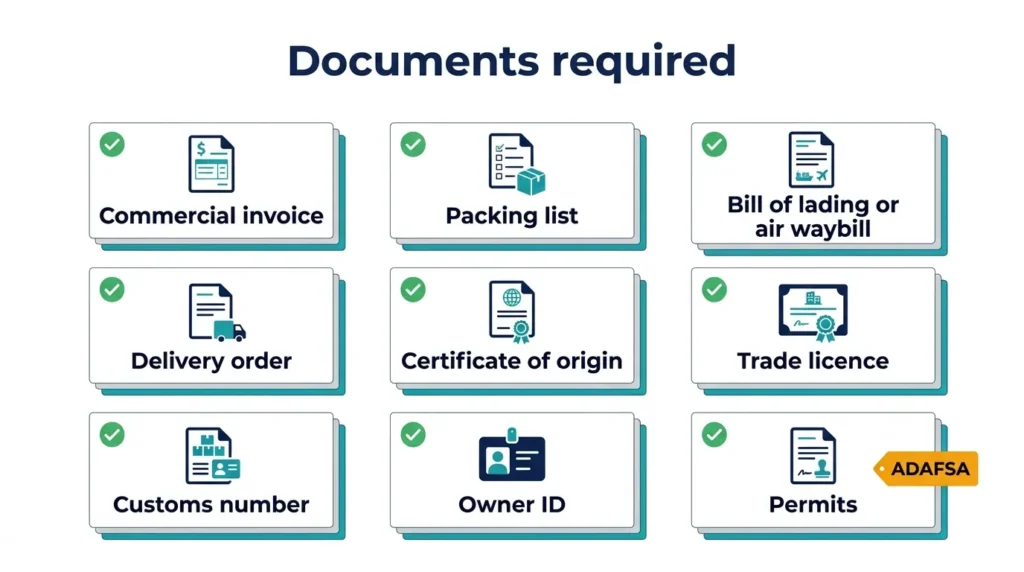
| Document | Why it is needed |
|---|---|
| Commercial invoice | Shows the value, which customs uses to calculate duty |
| Packing list | Shows boxes, weights and contents |
| Bill of lading (sea) or air waybill (air) | Proves the shipment and its routing |
| Delivery order | Authorises release from the shipping line or airline |
| Certificate of origin | Needed where origin affects duty or the goods require it |
| Trade licence | Proves the importer is licensed for the activity |
| Customs registration number | Identifies the importer or exporter on the declaration |
| ID of the owner or authorised signatory | Required for registration and delegation |
| Permits and certificates | For regulated goods such as food, chemicals and medicines |
Food products need approval from the Abu Dhabi Agriculture and Food Safety Authority (ADAFSA) before arrival. For a full checklist, see our guide to the documents required for customs clearance.
Customs Clearance Abu Dhabi: Costs and Fees
The cost has three parts: government charges, duty and tax, and any agent or handling fees.
- Customs duty: 5% of the CIF value (cost, insurance and freight) on most goods. See UAE customs duty and import tax.
- VAT: 5% on imports, charged on the value including duty.
- Government service fees: the federal customs service fee schedule lists an importer or exporter code for companies at AED 100 and renewal at AED 25, with small fees for services such as HS code requests and declaration cancellations. Fees can change, so confirm the current amounts on TAMM.
- Clearing agent fees: vary by shipment size, complexity and service. For a breakdown of typical charges, read our guide to customs clearance cost in Dubai, which applies broadly.
- Other charges: terminal handling, storage, inspection and transport from the port or airport.
If you want an exact figure, send your invoice, packing list and HS codes to a broker and ask for a written estimate that separates government charges from service fees.

Abu Dhabi vs Dubai Customs Clearance
The rules are shared, but the systems and registrations are separate. This is where many traders get caught.
| Factor | Abu Dhabi | Dubai |
|---|---|---|
| Customs authority | General Administration of Abu Dhabi Customs | Dubai Customs |
| Main online platforms | TAMM and ATLP | Dubai Trade and Mirsal 2 |
| Customs registration | Abu Dhabi registration needed | Dubai registration needed |
| Food regulator | ADAFSA | Dubai Municipality |
| Main gateways | Khalifa Port, Zayed Port, Abu Dhabi airport | Jebel Ali, Dubai airports |
| Mainland trade licence | Abu Dhabi Department of Economic Development | Dubai Department of Economy and Tourism |
If you import through both emirates, plan for two registrations and two sets of filings. For the Dubai process, see our customs clearance service.
Clearance by Air, Sea and Road in Abu Dhabi
The declaration is similar for every mode, but the documents and handling differ.
- Air: cargo arrives at Abu Dhabi airport with an air waybill. Pre-arrival filing lets cargo be released fast on landing.
- Sea: cargo arrives at Khalifa Port or Zayed Port with a bill of lading and a delivery order. A certificate of origin is commonly needed.
- Road: trucks entering at the Al Ghuwaifat border crossing can use a pre-arrival clearance system and a truck crossing permit, so the declaration is ready before the truck arrives.
Common Mistakes That Delay Customs Clearance in Abu Dhabi
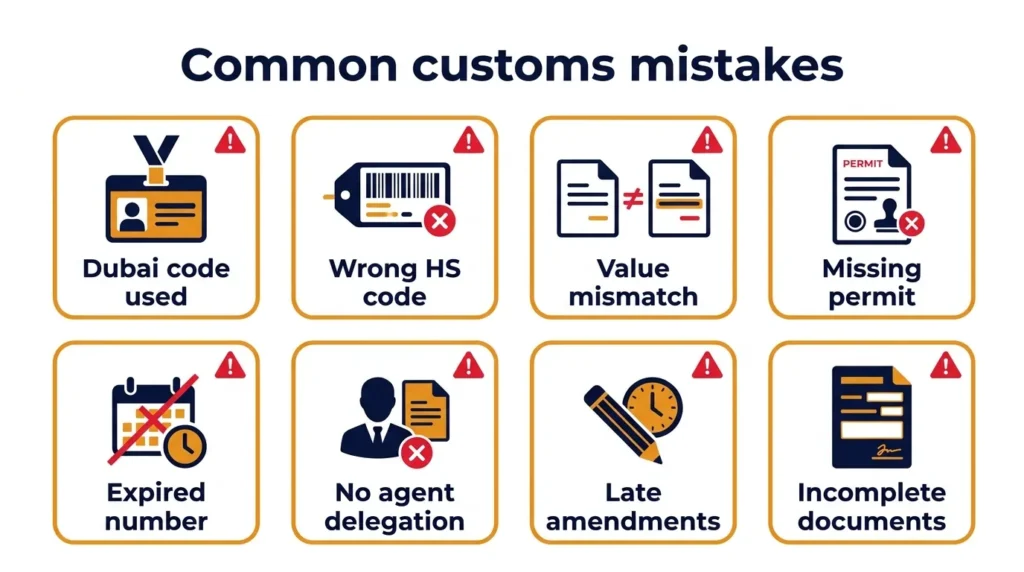
- Using a Dubai customs code for an Abu Dhabi shipment. Registrations are emirate-specific.
- Wrong HS code. It changes the duty and can trigger inspection or penalties.
- Value mismatch. The invoice, packing list and declaration must agree.
- Missing approvals. Food and regulated goods need permits before arrival.
- Expired customs registration. Renew it before it lapses, or filings stop.
- No agent delegation. If an agent files for you, they must be authorised in the system first.
- Late amendments. If the declaration changes or must be cancelled, notify customs through the correct service instead of ignoring it.
- Incomplete documents. Missing invoices or unsigned forms cause holds and storage fees.
Should You Use a Customs Clearing Agent in Abu Dhabi?
You can clear goods yourself, but most businesses use an agent because it saves time and reduces mistakes. An agent is useful when you import regularly, ship regulated goods, are unsure about HS codes, or move cargo through more than one emirate.
When choosing one, ask:
- Are they licensed and authorised in the Abu Dhabi Customs system?
- Will they give a written estimate that separates government fees from service fees?
- How do they check HS codes and values before filing?
- Can they also arrange transport from the port or airport?
- Who is your contact if the cargo is held?
Customs Clearance Support with Des Logistics
Des Logistics is a Dubai-based logistics company that handles customs, freight and warehousing from Business Bay. We prepare your documents and HS codes, coordinate the declaration, and arrange transport across the UAE, so you deal with one team from shipment to delivery. See our customs clearance service for how it works.
- Document checks before the cargo arrives
- HS code classification and duty estimates
- Customs declaration coordination
- Land transport across the emirates
- WhatsApp support on +971 55 8251353
Have a shipment coming through Abu Dhabi? Contact us with your invoice and packing list and we will tell you what is needed.

Frequently Asked Questions
How do I clear goods through customs in Abu Dhabi?
Hold a valid trade licence, get an Abu Dhabi customs registration number, file the declaration through TAMM or ATLP with your documents, pay duty and fees online, and collect the cargo once it is released.
What is the Abu Dhabi customs clearance procedure?
Register with Abu Dhabi Customs, classify the goods with the correct HS code, prepare the documents, file the declaration (ideally before arrival), pay duty and VAT, pass inspection if selected, and take delivery.
Which platform is used for customs clearance in Abu Dhabi?
Abu Dhabi uses TAMM, the government services platform, and ATLP, the Advanced Trade and Logistics Platform, for declarations, registrations and related services.
Can I use my Dubai customs code in Abu Dhabi?
Not automatically. Customs registrations are issued by each emirate, so check whether you need an Abu Dhabi registration before importing through Abu Dhabi.
What documents are needed for custom clearance in Abu Dhabi?
Typically a commercial invoice, packing list, bill of lading or air waybill, delivery order, trade licence, customs registration number and the owner’s ID. Regulated goods need extra permits.
How much is customs duty in Abu Dhabi?
Most goods attract 5% customs duty on CIF value, plus 5% VAT on imports. Some goods are exempt or have different rates, so confirm using the HS code.
Can a clearing agent file for me in Abu Dhabi?
Yes. You authorise the agent through the Clearance Agent Delegation service, and they can then submit declarations on your behalf.
What is pre-arrival customs clearance?
It means filing the declaration, paying duties and meeting any regulatory requirements before the goods reach the customs centre, so cargo can be released faster when it arrives.
Do food imports need extra approval in Abu Dhabi?
Yes. Food products need approval from ADAFSA before the shipment arrives, in addition to customs clearance.
Final Thoughts
Abu Dhabi customs clearance is simple once the basics are in place: a licence, an Abu Dhabi customs registration number, correct HS codes and matching documents. File before arrival where you can, confirm the permits for regulated goods, and make sure any agent is properly authorised. If you want help with the paperwork, contact Des Logistics