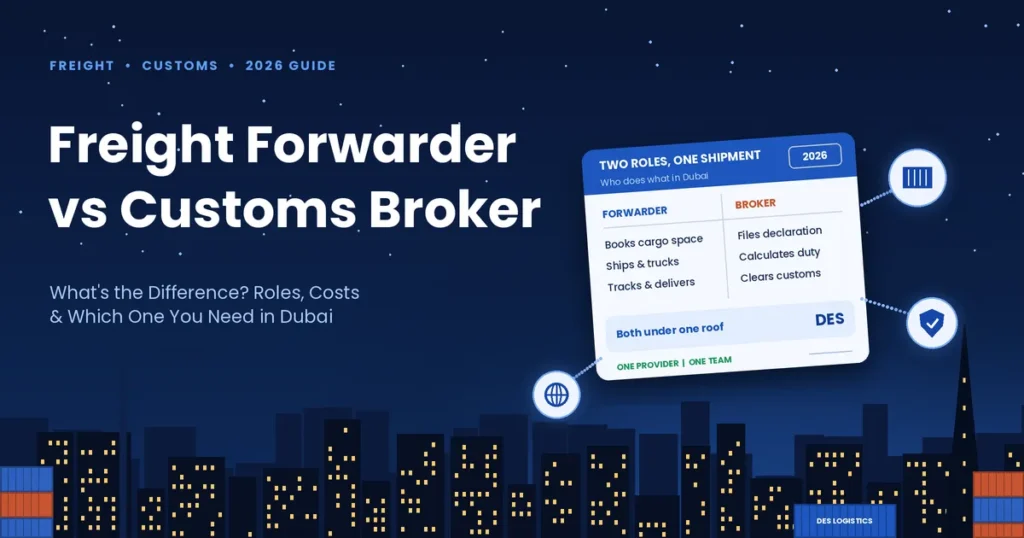
A freight forwarder arranges and manages the transport of your cargo, while a customs broker declares your goods to customs and gets them legally cleared. Put simply, the forwarder gets your shipment there, and the broker gets it through the border. In Dubai, where cargo moves daily through Jebel Ali Port and Dubai International Airport and every declaration is filed electronically, the two jobs are closely linked. Many companies, including DES Logistics, offer both, but they are still two different jobs, and knowing which you need saves time, storage charges and money. This guide explains what each role does, how fees differ, and whether you need one provider or two.
What Does a Freight Forwarder Do?
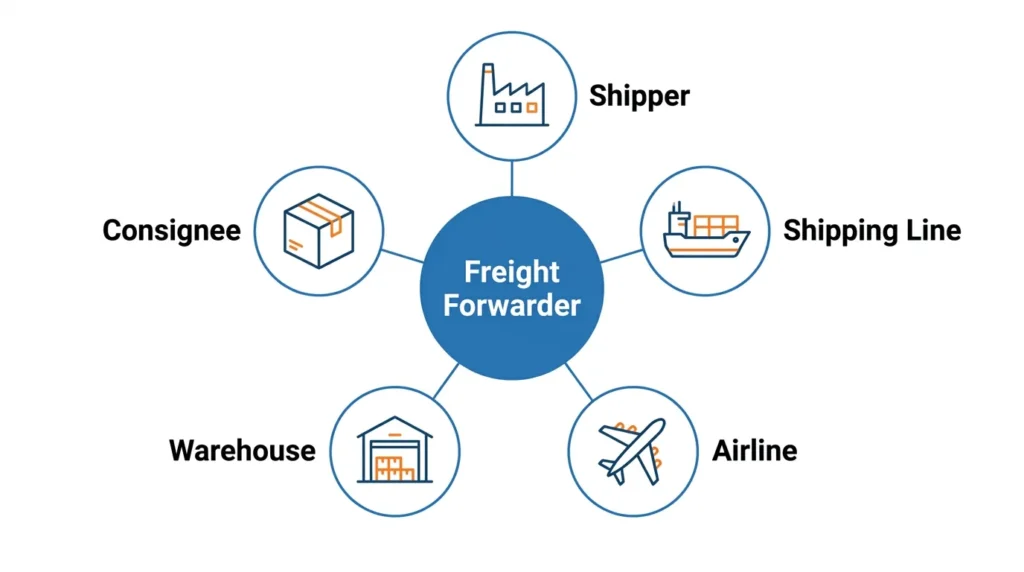
A freight forwarder is your logistics coordinator. Most forwarders don’t own the ships, aircraft or trucks that carry your goods. Instead, they use their relationships with carriers to organise the whole journey for you, and because they book cargo space in volume, they can often secure better rates and schedules than a business booking alone.
- Mode and route planning — Choosing sea, air, road or a combination, based on your budget, deadline and type of cargo
- Booking and rate negotiation — Reserving space with shipping lines, airlines and trucking companies
- Cargo consolidation — Combining smaller shipments (LCL sea freight or air consolidation) so you only pay for the space you use
- Shipping documentation — Preparing or coordinating the bill of lading or air waybill, packing list and related paperwork
- Cargo insurance — Arranging cover for loss or damage in transit
- Warehousing and delivery — Storage, pick-up and last-mile delivery to your door
- Tracking and problem-solving — Following the shipment and rebooking or rerouting when there are delays
Any business moving commercial cargo across borders can benefit from one: importers, exporters, manufacturers, traders and e-commerce sellers. If your shipment involves more than one carrier or country, a forwarder takes a lot of coordination off your plate. You can read more about our freight forwarding services.
What Does a Customs Broker Do?
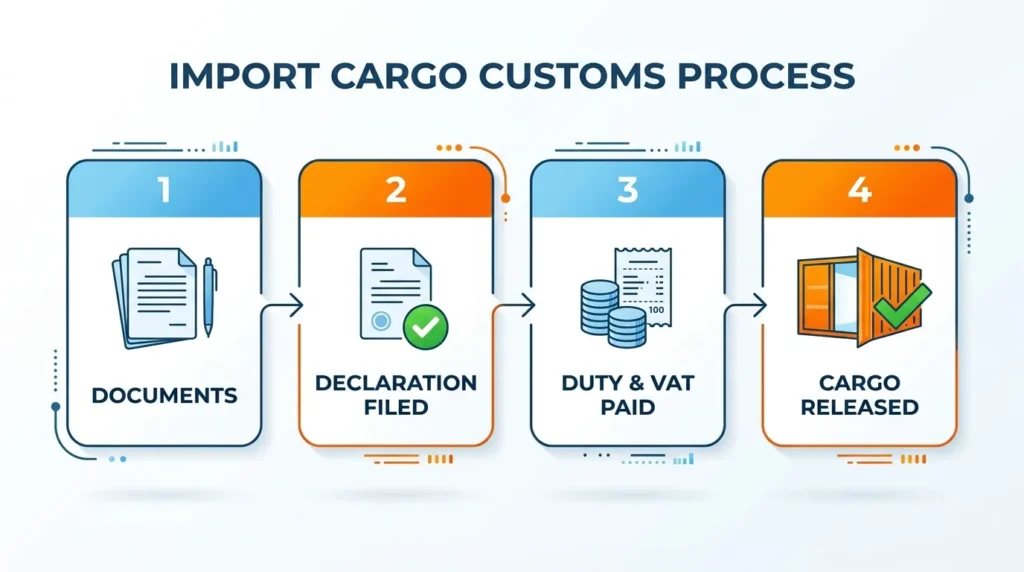
A customs broker deals with the legal side of moving goods across a border. Every shipment entering or leaving the UAE has to be declared to customs, classified correctly and cleared before it can be released. The broker prepares and files that paperwork on your behalf and makes sure you meet the rules.
- HS code classification — Assigning the correct HS code to each product, which decides the duty rate (see our HS Code Guide)
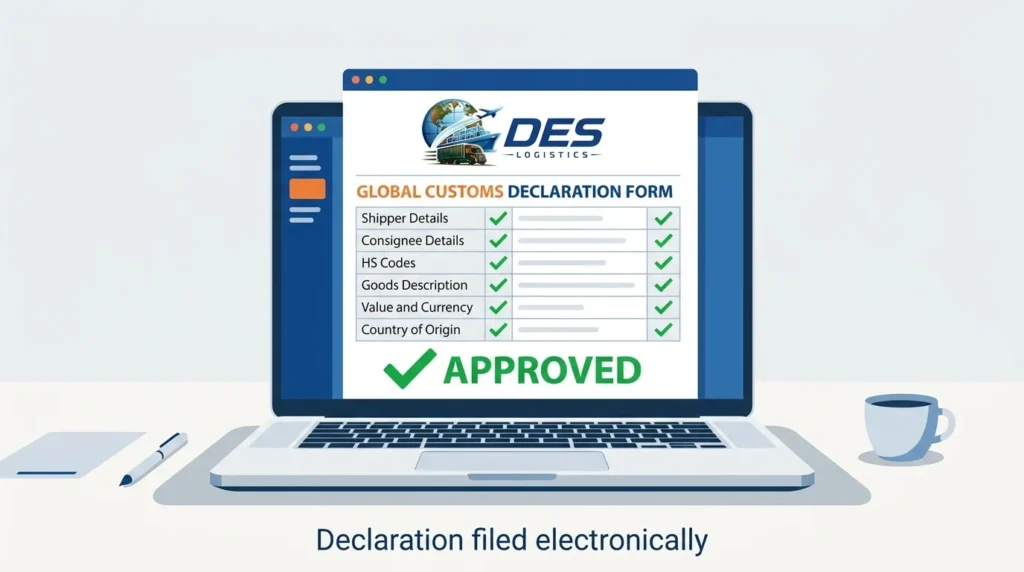
- Customs declarations — Preparing and submitting the declaration with the commercial invoice, packing list, bill of lading or air waybill, and certificate of origin where needed
- Duty and VAT calculation — Working out what you owe and arranging payment
- Permits and approvals — Checking whether your goods need approval from other government bodies (such as food, health or environment regulators) before clearance
- Inspections and queries — Representing you if customs asks for a physical inspection or more information
- Fixing problems — Correcting declarations and resolving holds so your cargo isn’t stuck accruing storage charges
Customs Broker Dubai — How Clearance Works Locally
In Dubai, customs declarations are submitted electronically through Mirsal 2, Dubai Customs’ declaration system, which runs through the Dubai Trade portal. Import, export and transit declarations all go through it. A declaration is filed either by a licensed customs broker Dubai businesses hire (also called a clearing agent) or by a registered importer that is set up to file directly.
Two practical points matter here:
- Timing — Declarations work best when they are prepared before the cargo arrives, whether that’s a vessel due at Jebel Ali or a flight into Dubai International Airport. Filing early gives time to fix problems before storage charges start.
- Accuracy — Small mismatches, such as a different quantity on the invoice and the packing list, can flag a declaration for manual review. A broker’s pre-submission check exists to catch exactly this.
For the full process, see our customs clearance services.
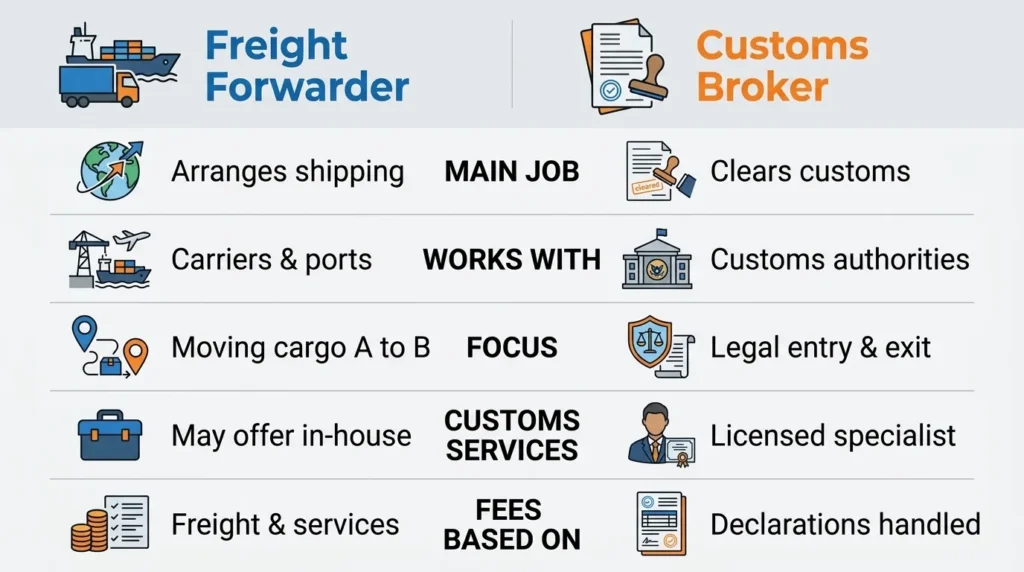
Freight Forwarder vs Customs Broker: Side-by-Side Comparison
| Freight Forwarder | Customs Broker | |
|---|---|---|
| Main job | Arranges shipping and logistics | Handles customs clearance and compliance |
| Works with | Carriers, ports, warehouses | Customs authorities and regulators |
| Focus | Getting cargo from A to B | Legal entry and exit of goods |
| Customs services | May offer in-house customs clearance | Usually a licensed specialist |
| Key documents | Booking confirmation, bill of lading or air waybill | Customs declaration, HS code, duty and VAT calculation, permits |
| When they’re involved | From pick-up to final delivery | At the clearance stage (import, export or transit) |
| Fees based on | Freight charges, volume and services used | Declarations handled (duty and VAT are government charges passed through) |
How a Dubai Shipment Moves — Who Does What
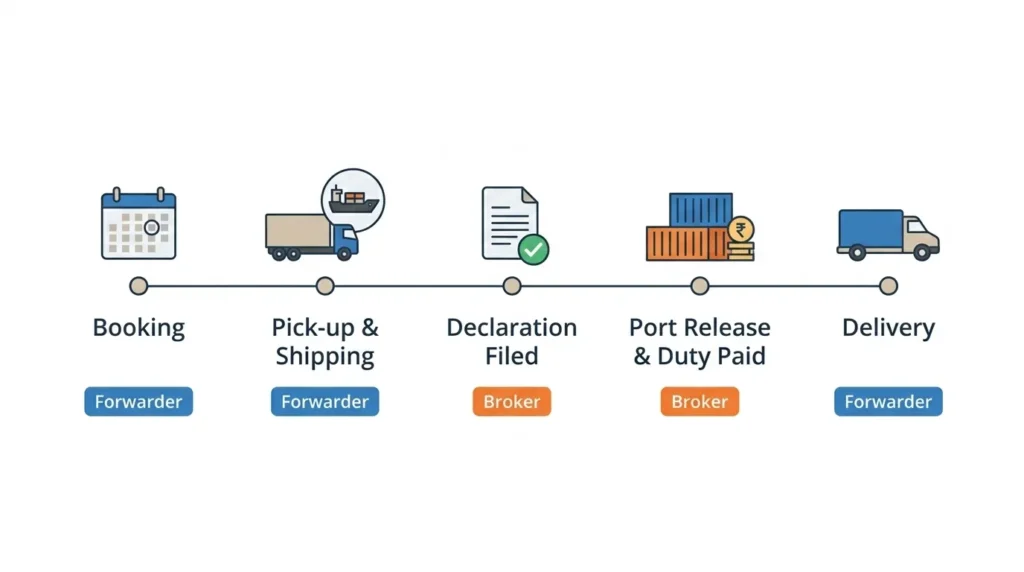
The easiest way to see the difference is to follow one shipment. Here is a typical sea import into Jebel Ali:
- Before shipping — The forwarder quotes the freight, confirms the route and books space with the carrier. The broker (or the forwarder’s customs team) checks the HS code and whether any permits are needed.
- Cargo leaves origin — The forwarder coordinates pick-up, the bill of lading and tracking.
- Before arrival — The broker prepares the customs declaration and submits it through Mirsal 2 ahead of the vessel’s arrival.
- Arrival at port — The forwarder handles the port and release formalities on the transport side. The broker pays duty and VAT, deals with any inspection and gets the cargo released.
- Delivery — The forwarder arranges trucking to your warehouse or site.
Exports work the same way in reverse: the forwarder arranges transport out of the UAE, while the export declaration still has to be filed before the goods can leave.
Who Pays What? Understanding the Fees
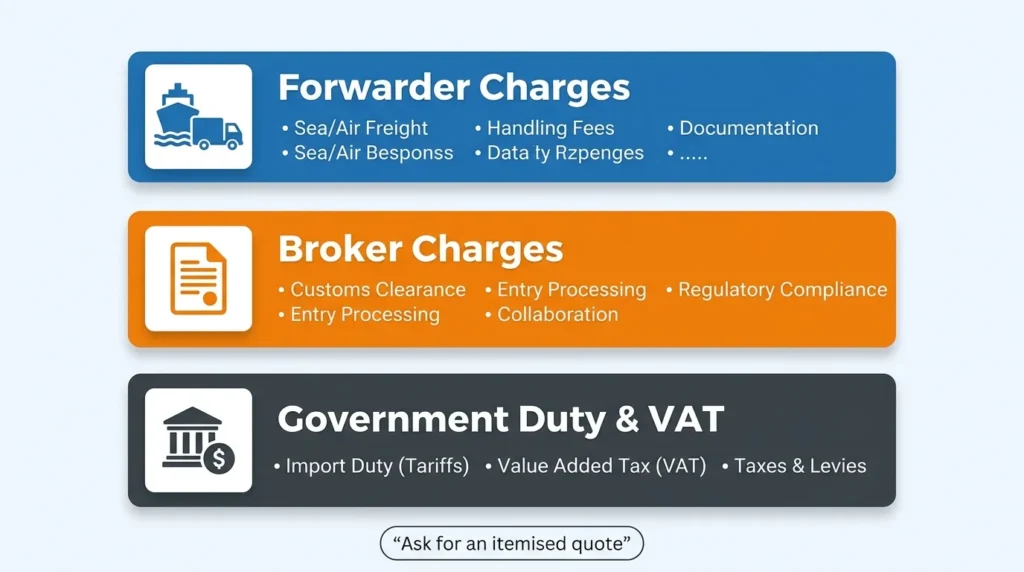
A single shipment involves three different kinds of charges:
- Freight forwarder charges — Freight (sea, air or road), origin and destination handling, documentation, and extras such as insurance, storage or delivery
- Customs broker charges — A service fee for preparing and filing the declaration, plus any permit or inspection-related handling
- Government charges — Customs duty and VAT. These aren’t fees kept by the forwarder or broker; they are paid to the authorities, usually through your broker, and then billed to you
For most goods, the standard customs duty is 5% of the CIF (Cost, Insurance, Freight) value, and VAT is 5%. Rates depend on the HS code, and some goods are exempt or taxed differently. Ask every provider for an itemised quote so you can see freight, clearance fees and government charges separately. For a full breakdown, see our Customs Clearance Cost guide.
Do You Need Both?
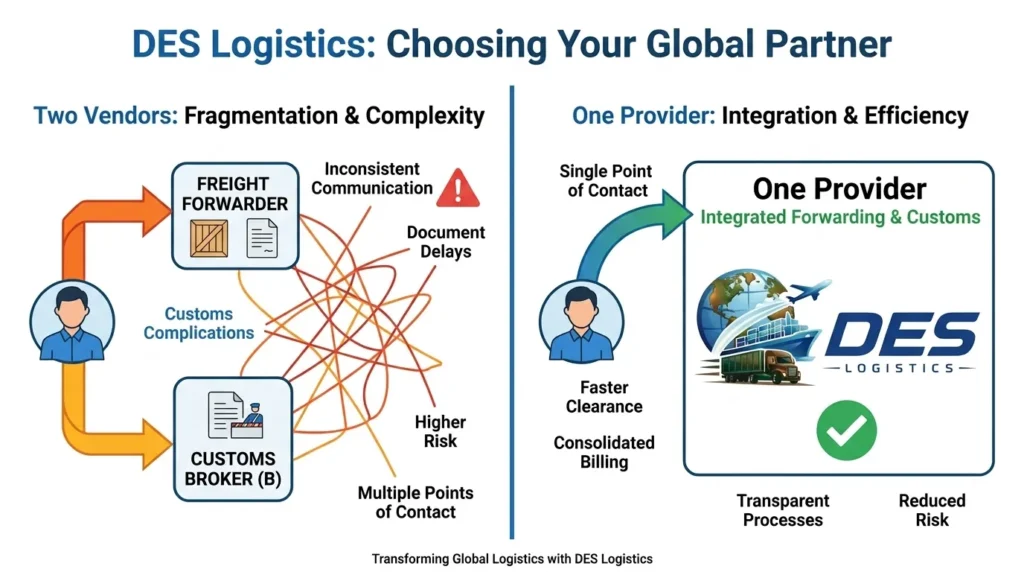
For most importers and exporters, yes: both jobs have to be done. Someone has to move the cargo, and someone has to clear it. The real question is whether you want to coordinate two vendors or work with one company that does both.
- Regular importers of general goods — One provider handling freight forwarding and customs clearance means a single point of contact and one team keeping transport and clearance in step
- Businesses importing regulated goods (food, cosmetics, chemicals, medical products) — These often need permits from other authorities, so choose a provider with proven experience in your product category
- Companies with their own customs registration and team — You may only need a forwarder for transport
- Small or occasional shippers — A single provider handling everything is usually the simplest and least error-prone option
When the forwarder and the customs team work under the same roof, they share the same shipment information, so there are fewer handovers, fewer chances for documents to go missing, and one company accountable if something goes wrong. That’s why DES Logistics offers freight forwarding and customs clearance in-house: you brief one team, and we coordinate both the movement and the clearance of your cargo. An independent broker can still make sense if you have a long-standing relationship with one, or your goods are highly specialised.
Freight Forwarders in Dubai — Why Local Expertise Matters
Dubai is one of the busiest trade hubs in the region. Jebel Ali Port is a major container hub, and Dubai’s airports handle large volumes of international air cargo. Freight forwarders in Dubai with real local experience know how these ports and terminals work, which carriers serve which routes, and what documents are expected at each point. A few local details a good forwarder will already understand:
- Free zone and mainland movements — Goods moving between free zones, the mainland and other emirates can involve different customs procedures
- Electronic filing — Declarations go through Mirsal 2 on the Dubai Trade portal, so document accuracy and timing matter
- Permits — Some product categories need approvals before clearance, and knowing this in advance avoids delays
Freight Forwarders Near Me — What to Check Before You Choose
If you’re searching for freight forwarders near me in Dubai, distance matters for pick-ups, warehousing and site visits, but capability matters more. Check that the company:
- Holds a valid trade licence and gives clear company details
- Offers in-house customs clearance, or names the partner who does it
- Has experience with your cargo type and trade route
- Gives itemised quotes with no vague “all-in” pricing
- Can arrange cargo insurance
- Provides shipment tracking and answers questions quickly
Which One Do You Need? Quick Decision Guide
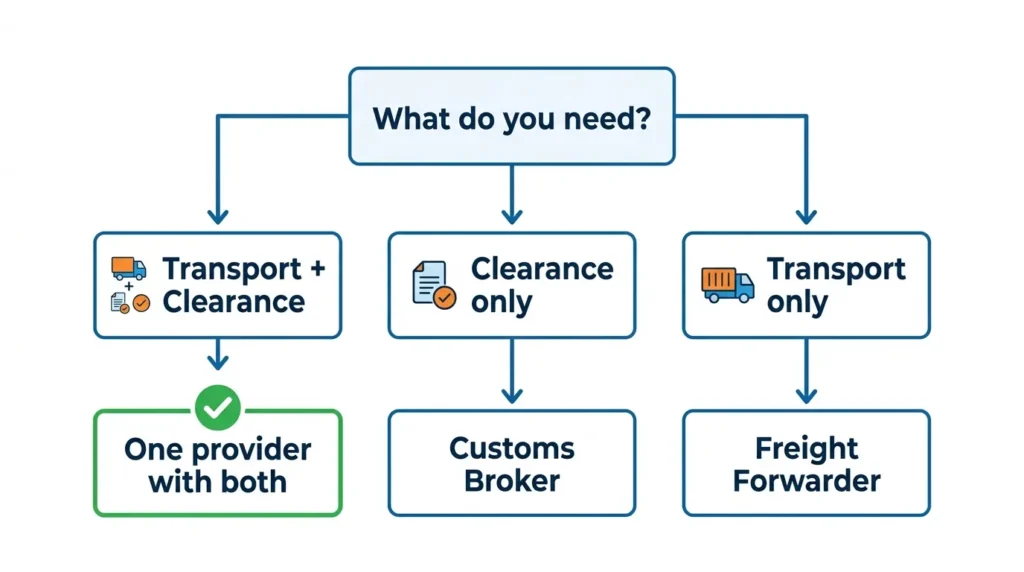
- You want door-to-door service and don’t want to manage several vendors — Choose a freight forwarder with in-house customs clearance
- Your supplier already arranges transport to Dubai and you only need goods cleared — Choose a customs broker (clearing agent)
- You have your own customs registration and team — Choose a freight forwarder for transport only
- You import regulated goods that need permits — Choose a provider with proven experience in that product category
- You’re not sure — Ask two or three providers for itemised quotes and compare what each one covers
Common Myths
- “They’re the same thing.” They aren’t. A forwarder moves cargo; a broker clears it. Some companies do both, which is where the confusion starts.
- “If I hire a forwarder, customs is automatically covered.” Not always. Some forwarders clear customs in-house, others hand it to a partner, and some leave it to you. Always ask.
- “The cheapest quote is the best deal.” A low freight rate can hide missing clearance, handling or storage charges. Compare what is included, not just the headline number.
Frequently Asked Questions
Is a freight forwarder the same as a customs broker? No. A freight forwarder arranges and manages the transport of your cargo. A customs broker handles customs declarations, duty and VAT, and compliance. The roles are different, although one company can provide both.
Can one company do both jobs? Yes. Many freight forwarders in Dubai also have in-house customs clearance, which means one team can manage transport and clearance together. At DES Logistics, we offer both under one roof, so you deal with a single provider from pick-up to delivery.
Do I need a customs broker if I use a freight forwarder? It depends on your forwarder. If they provide customs clearance in-house, you don’t need to hire a separate broker. If they only handle transport, someone else must file the customs declaration. Ask upfront whether clearance is included and who is responsible for it.
Who is responsible for customs duty payment? The importer is normally responsible for duty and VAT. In practice, your customs broker (or your forwarder’s customs team) pays the charges to the authorities on your behalf and invoices you. The exception is when the sale terms make the seller responsible, for example under DDP terms.
How do I choose between the two for my shipment? Ask what you actually need. If you only need goods cleared, a customs broker is enough. If you need transport, choose a forwarder. If you need both, which is common, a provider that offers freight forwarding and customs clearance together is usually the simplest option.
Can I clear my own goods without a customs broker? Yes, if your company is registered with Dubai Customs and set up to file declarations directly. Many businesses still prefer a broker because HS classification, permits and document accuracy are easy to get wrong, and mistakes can mean delays and extra charges.
Does a freight forwarder in Dubai need a licence? Yes. A freight forwarder needs a valid trade licence to operate, and customs clearing agents must also be registered with Dubai Customs. Ask any provider to confirm their licence details before you book.
Final Thoughts
A freight forwarder and a customs broker do different jobs, and both are needed to move goods in and out of Dubai smoothly. What matters is knowing who is responsible for each step, and choosing a partner who can either handle both or work closely with the specialist who does. Getting that clear before you ship is often what separates a smooth shipment from one that is stuck at the port.
Still not sure which service you need? Contact DES Logistics — we handle both under one roof.